Quantum AI pairs a quantum processor with ordinary machine learning. Qubits can hold a blend of values, and a circuit can be built so better answers become more likely. The useful work is narrow: simulating molecules, searching huge combinations, and sampling awkward distributions. Language, vision, and most product features stay on classical hardware.
Traditional AI, including the models behind search, language, and computer vision, runs on ordinary computers. Those machines are fast. They still store each unit of information as a bit, which is either 0 or 1, and they work through a problem as a sequence of definite steps.
Quantum AI is what you get when a quantum processor is placed inside that workflow. The quantum part uses qubits, which follow quantum physics. The classical part still prepares the data, trains the settings, and returns an answer a person can use. Together they can attack a few families of problem that grow brutally expensive on ordinary hardware. They leave the rest of AI where it already works.
Key principles
Three ideas explain the hardware. Superposition sets up many options at once. Interference ranks them. Entanglement lets the options depend on each other.
Superposition
A bit is a switch. It is on or off. A qubit can be prepared in a blend of 0 and 1 at the same time, with a size and a phase for each part. The spinning-coin picture is a fair way to remember this. While the coin is spinning it is neither a settled heads nor a settled tails.
Catch the coin and you get one face. Measure a qubit and you get a single 0 or 1. The blend is gone. Quantum AI does its work before that measurement, by arranging the blend so the useful results are the ones you are likely to see.
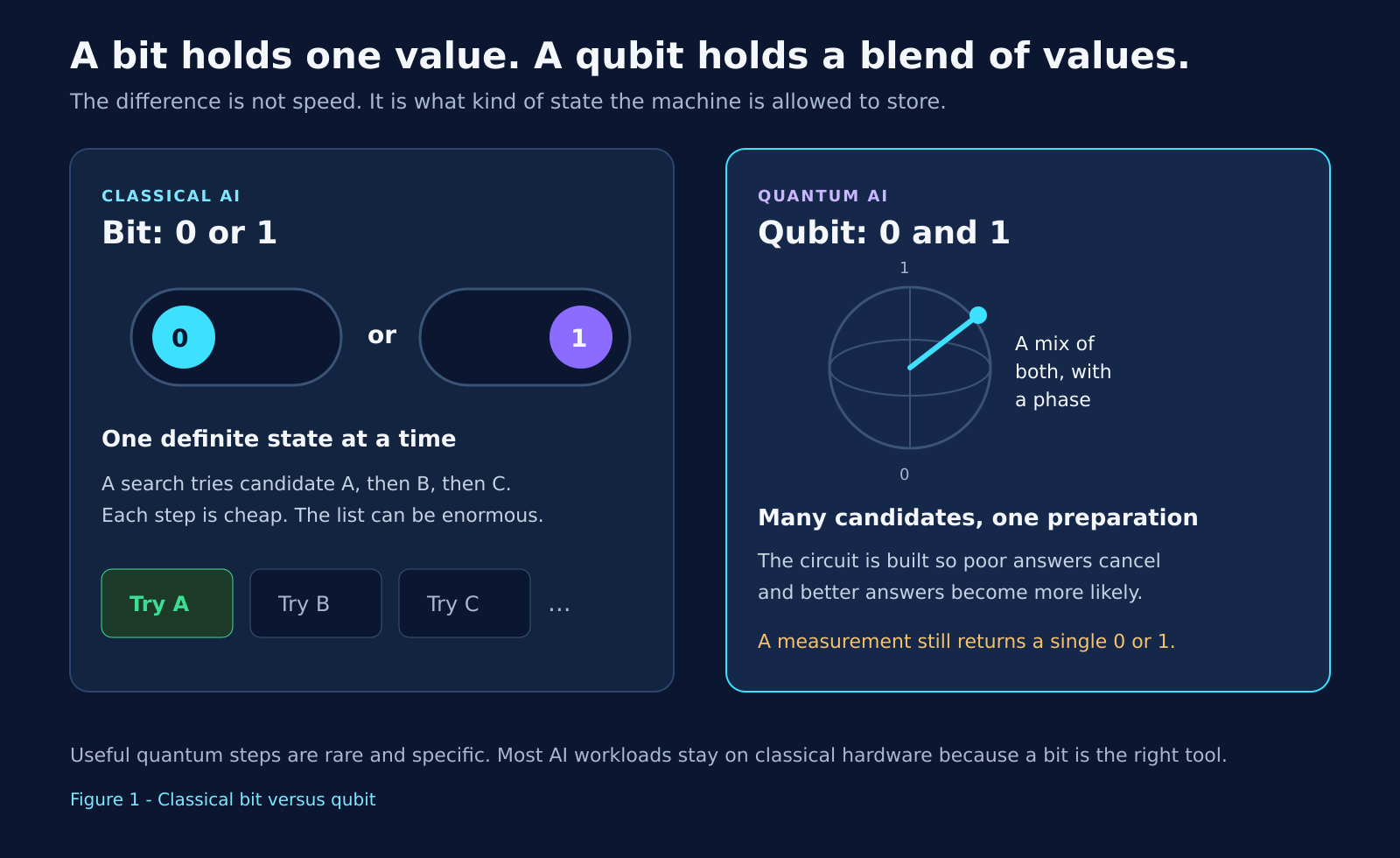
Figure 1. A bit is one value. A qubit is a prepared blend, and a measurement still returns one value.
Interference
Superposition on its own is only a way to hold options. Interference is what ranks them.
Each possible answer has an amplitude. Amplitudes add the way waves add. Where they line up, that answer grows more likely. Where they oppose, that answer fades. A quantum algorithm is a recipe for that pattern: prepare the options, let the poor ones cancel, then measure.
You still run the circuit many times and read a histogram. You have shaped the odds. You have not printed every answer at once.
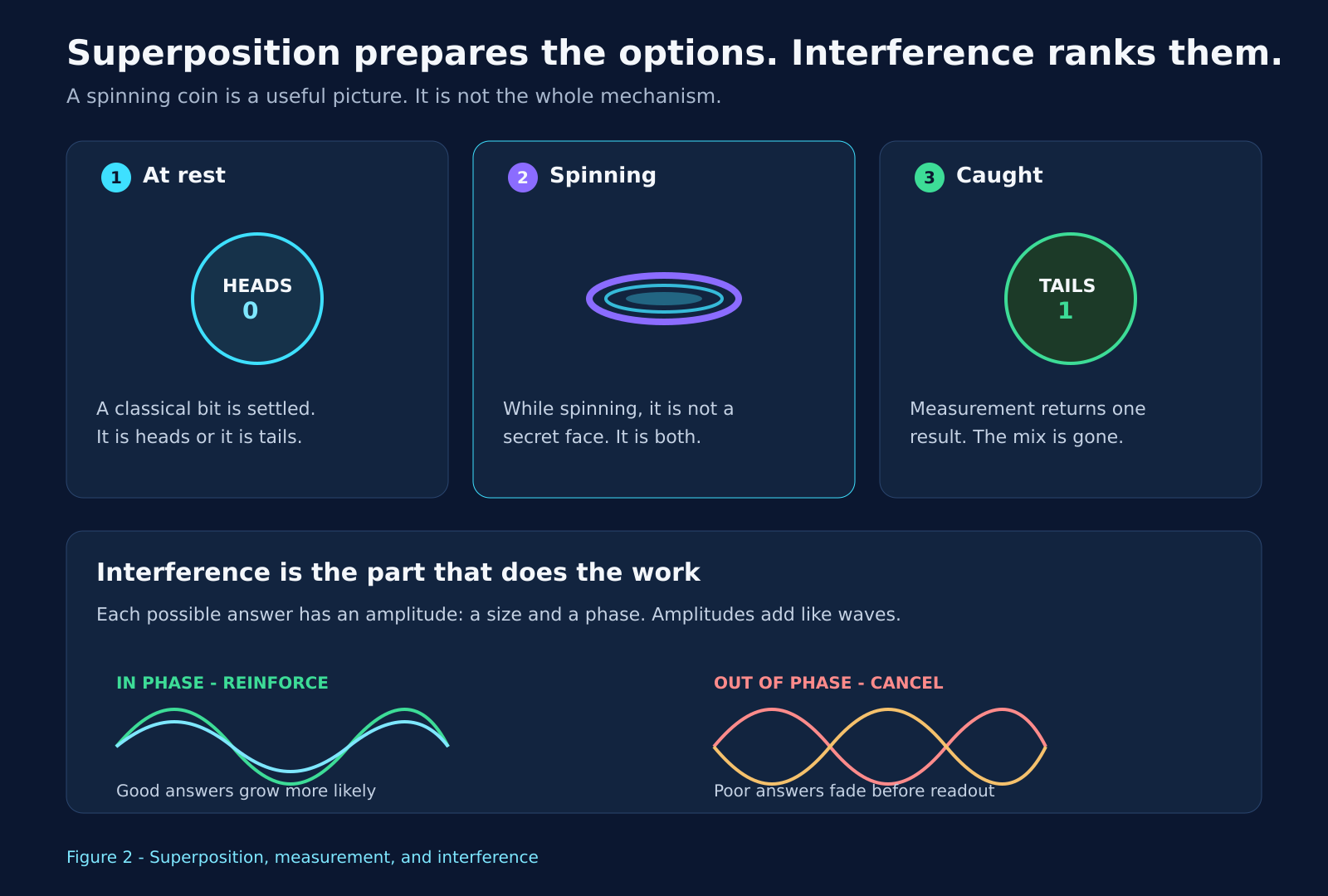
Figure 2. Superposition prepares the options. Interference makes the better ones more likely.
Entanglement
Quantum particles can be prepared so that they share one description. Measure one and you learn something about the other, including when they are far apart. For a computation, entanglement means the qubits are one system. A circuit can represent relationships across many variables in a single state, which is why it is interesting for molecules, routes, and portfolios.
The correlation shows up when both results are brought together and compared. Entanglement is a shared state. It is a poor metaphor for a radio. It does not give you a channel that carries a usable message.
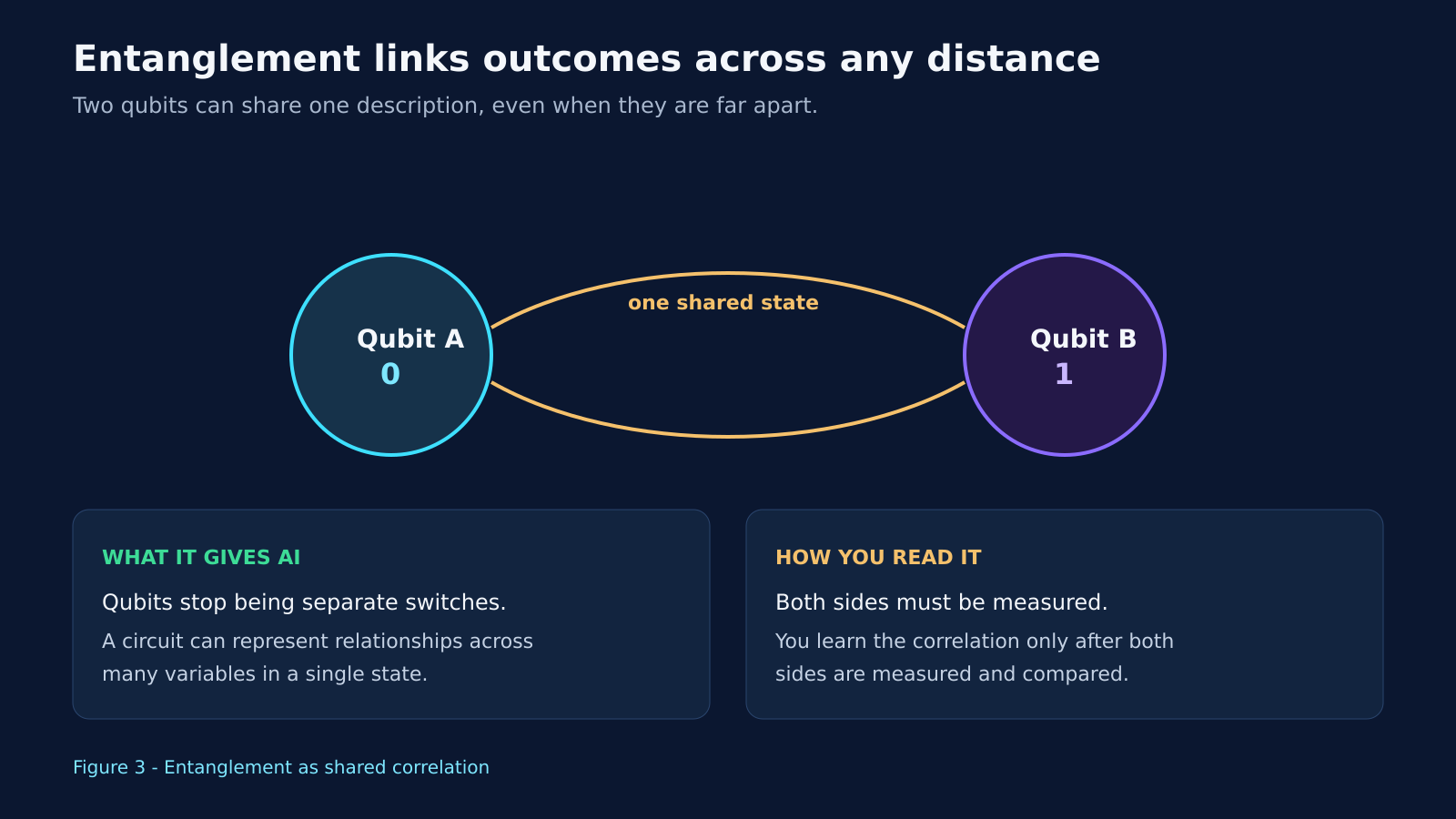
Figure 3. Entangled qubits share one description. You see the link by comparing both measurements.
How a Quantum AI system actually runs
The working pattern is a loop. A classical computer owns the job. A quantum chip handles one hard step, then hands numbers back.
- Start with the data: a molecule, a set of routes, a portfolio, a grid.
- Encode the important features as rotations and other operations on qubits.
- Run a short quantum circuit that entangles those qubits and sets up interference.
- Measure, many times, and build a histogram.
- Let a classical optimiser or a conventional model update the circuit's settings.
- Repeat until the settings stop improving, then publish the best answer.
Three names cover most of the serious proposals.
VQE, the variational quantum eigensolver, estimates the energy of a molecule. The quantum chip prepares a candidate state. The classical computer tweaks that state until the estimated energy is as low as it can get.
QAOA, the quantum approximate optimisation algorithm, targets combinatorial problems: routes, schedules, assignments. It alternates between a "follow the constraints" step and a "prefer the cheaper answer" step.
A quantum kernel uses a circuit to score how similar two examples are. A classical classifier then does the actual decision. The quantum part is a feature map, which is a familiar machine-learning idea in a new medium.
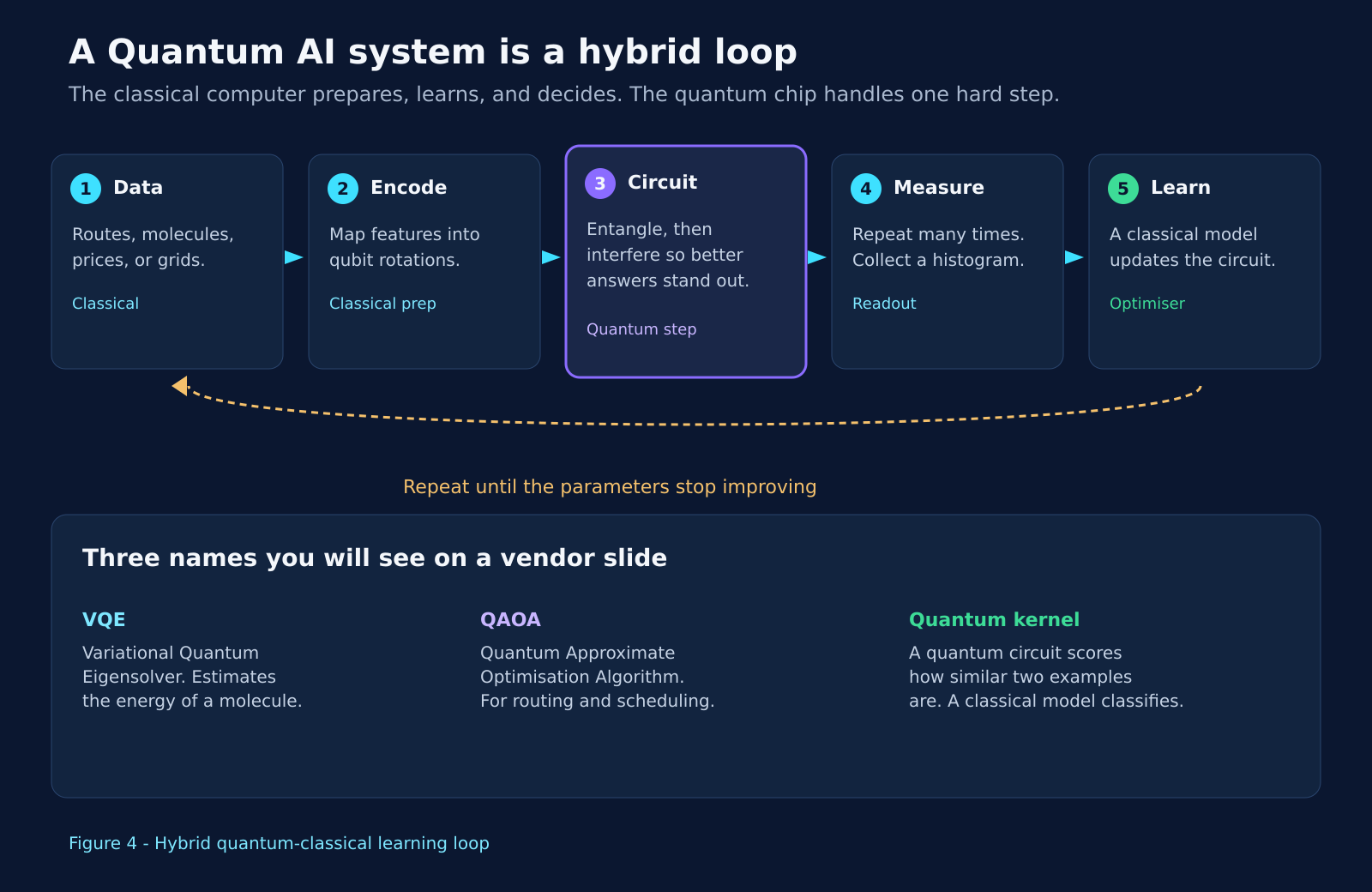
Figure 4. The classical machine prepares, learns, and decides. The quantum chip runs one hard step inside the loop.
Which problems are worth a quantum step
The right question is which step is expensive.
A quantum step earns its place when the problem is already quantum, when the number of combinations explodes, or when you need samples from a distribution that ordinary random numbers struggle to match. Molecular energy is the clearest case, because the electrons were quantum before anyone tried to simulate them. Routing, scheduling, and some portfolio choices are the combinatorial case. A few sampling tasks sit in the third group.
Chat, search, coding agents, images, speech, recommendations, and ordinary business forecasts are classical jobs. GPUs already fit them. A qubit does not make a better language model. If a strong solver on a normal server already finishes the job, the quantum version has to beat that solver, on the same problem, before it belongs in the architecture.
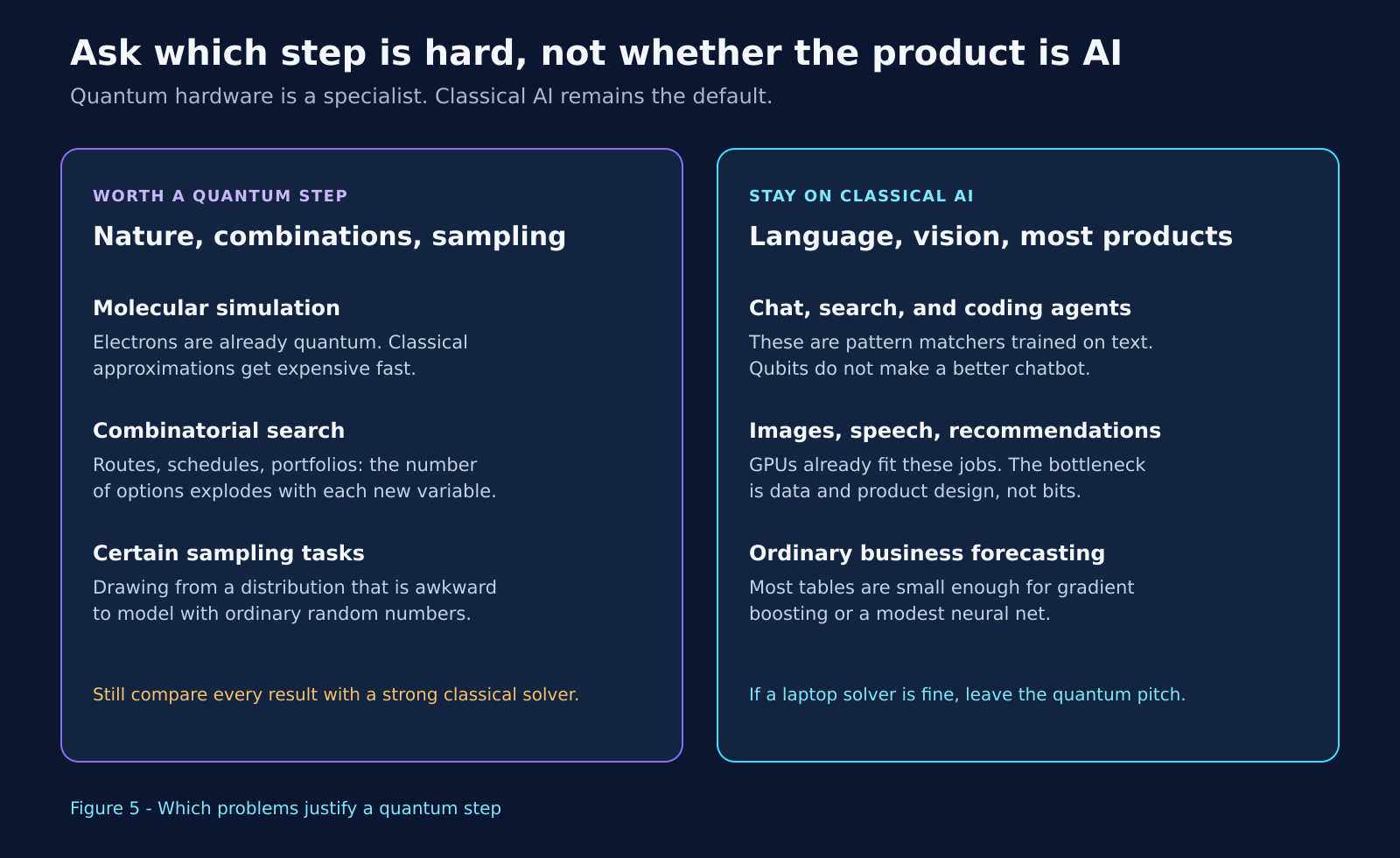
Figure 5. Simulate, search, or sample. Leave language, vision, and ordinary tables on classical AI.
How Quantum AI will change the work
The same pattern shows up in four places. In each one, the quantum step is a simulation or a search. The surrounding product stays classical: data collection, safety checks, and the decision a person signs.
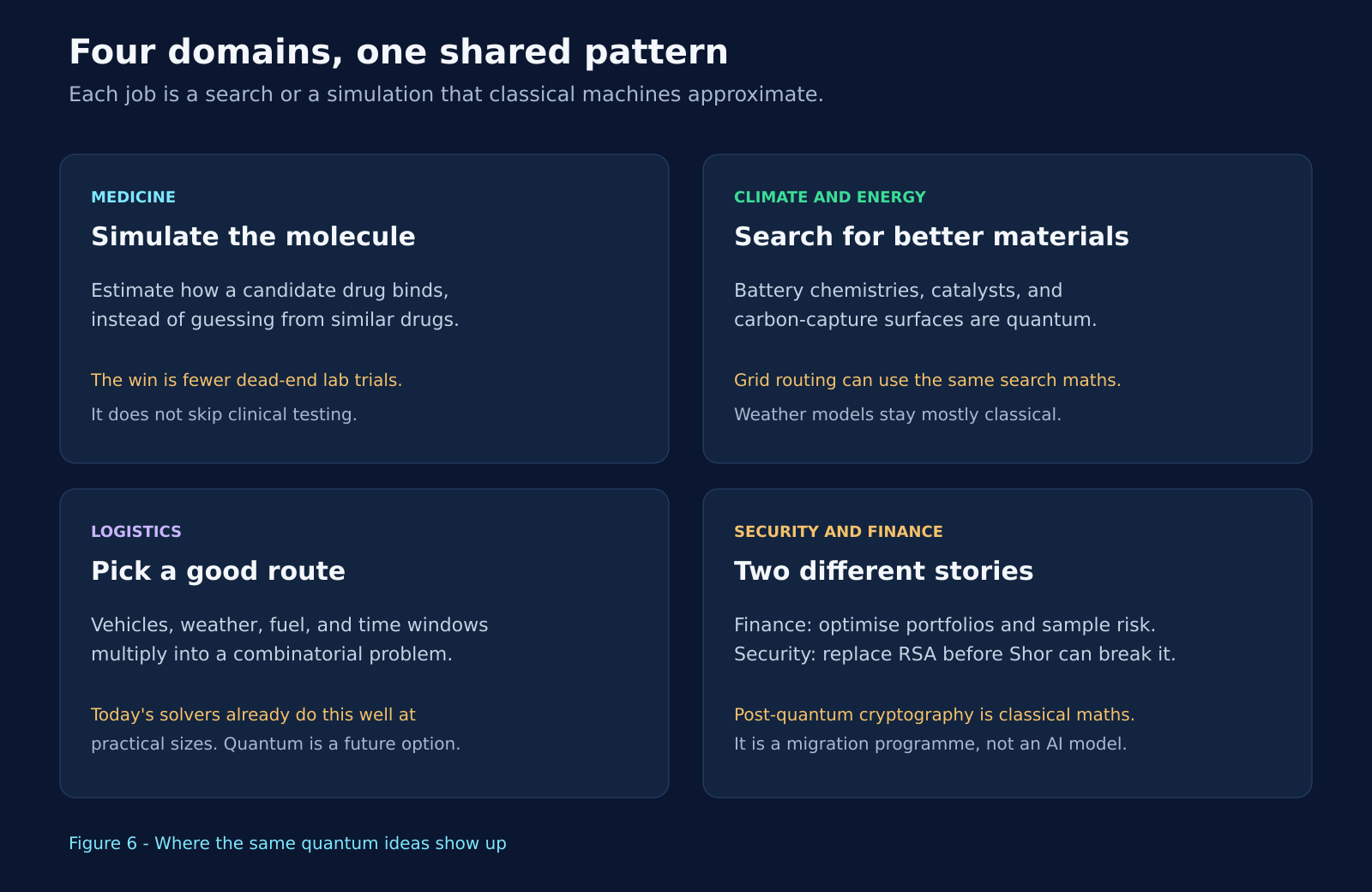
Figure 6. Four domains, one pattern: a hard simulation or search, with the rest of the system unchanged.
Medicine and healthcare
Designing a drug is slow because chemistry is a search through molecular shapes, and because a promising shape still has to survive the lab and the clinic. Classical models already help, by predicting which known molecules look similar to past successes. They approximate the physics.
A quantum chemistry step aims at that physics directly. VQE and its successors estimate how a candidate binds, or how a reaction proceeds, from the electrons rather than from a lookup of similar drugs. The practical prize is fewer dead-end syntheses. Clinical trials remain. Genetics-based treatment still depends on data, regulation, and a clinician. Quantum AI shortens the part of the search that is currently a rough approximation.
Climate and energy
Better batteries, better catalysts, and surfaces that capture carbon are materials problems. The binding energies and reaction paths are quantum chemistry again, so the same hybrid loop applies. A useful result is a shorter list of compounds worth making in a lab.
Power grids add a second kind of problem. Choosing how to route electricity, when to charge storage, and which plant to run is a large constrained search. That search can share mathematics with logistics. Weather and climate models are a different beast. They are huge classical simulations of fluids, and a quantum chip is the wrong place to put them.
Logistics and autonomous systems
A fleet, a set of time windows, a fuel price, and a weather forecast multiply into a combinatorial problem. Classical operational research solvers already do this well at the sizes companies run today. Quantum optimisation, including QAOA and quantum-annealing machines, is a bet that some of those searches will outgrow the classical solvers.
Autonomous vehicles do not need a qubit to see a pedestrian. Perception stays on classical models. The quantum-shaped question is coordination: which vehicle takes which job, in which order, under changing constraints.
Cybersecurity and finance
These are two stories that often get folded together.
Finance, where it meets quantum computing, is mostly optimisation and sampling. A portfolio is a search over combinations of assets under risk constraints. Some risk calculations need many samples from a complicated distribution. Both sit in the "worth a quantum step" column, and both still have to beat the classical tools desks already trust.
Security is a calendar problem. Shor's algorithm, on a future fault-tolerant quantum computer, breaks the public-key cryptography used for RSA and elliptic curves. The defence is already classical. Post-quantum cryptography replaces those algorithms with new ones designed to resist that attack. NIST has published the first standards, including ML-KEM for key agreement and ML-DSA for signatures. Moving to them is an engineering programme: inventories, certificates, long-lived documents, and vendors. It is separate from training a model.
Quantum key distribution is a third, smaller story. It uses physics to share a key on a dedicated link. It does not make a network "unbreakable," and it is not an AI technique.
What you can treat as real
Devices you can rent today are real, and they are noisy. They have enough qubits for experiments and for teaching the hybrid loop. They are small, they lose their state quickly, and they do not speed up general AI.
The next stage is narrow pilots. Error mitigation, and the first useful error-corrected qubits, will make a few workloads less fragile. Expect demonstrations that beat a weak baseline. Ask for the comparison against a strong classical solver on the same instance. A win on one problem class is the honest claim.
Fault-tolerant machines come later. That is the point at which deep algorithms, including Shor, and large molecular simulations both become serious. Cryptography has to move before that day, because data recorded now can be decrypted then. Product AI does not have to move at all, unless one of your actual bottlenecks is a simulation or a combinatorial search.
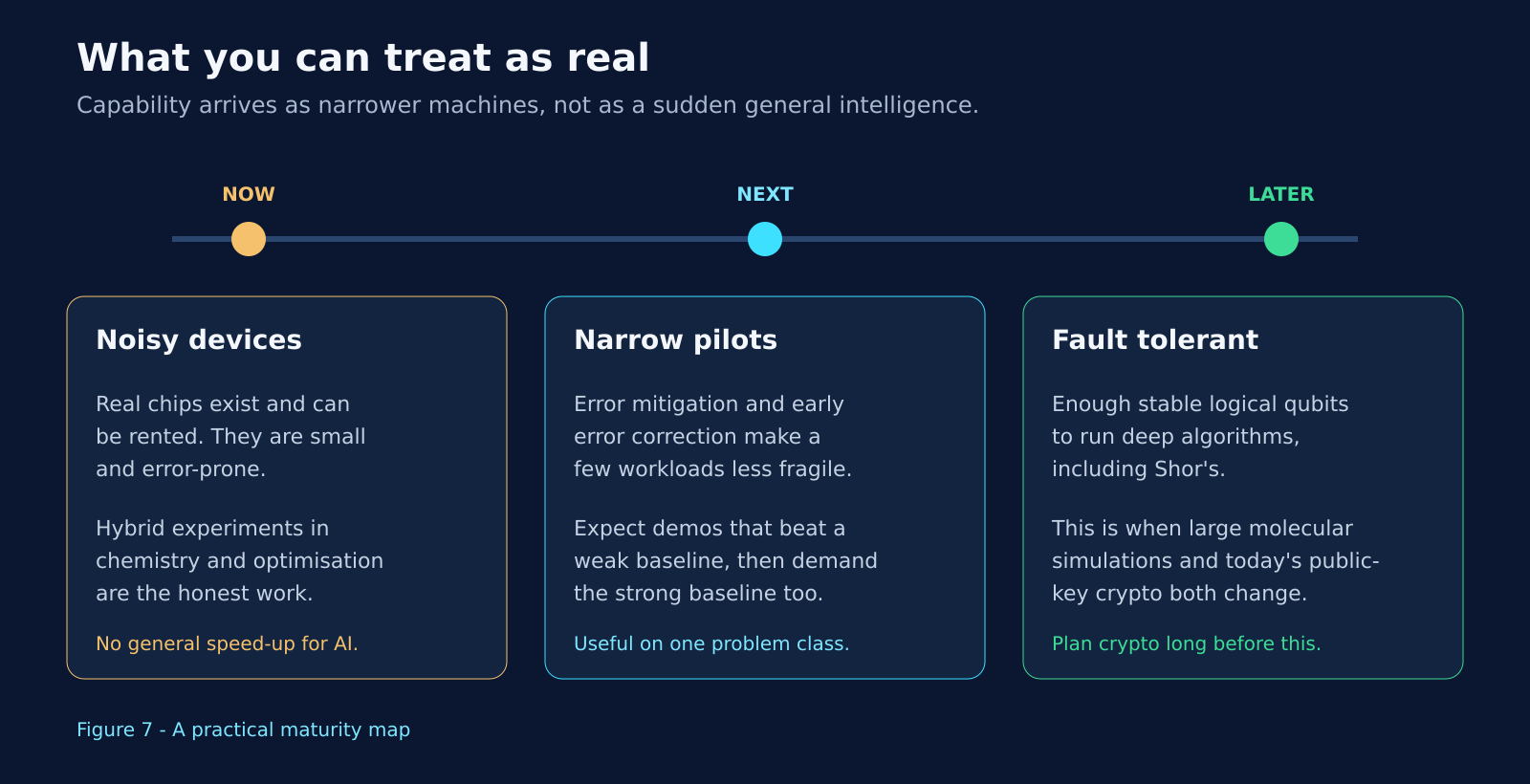
Figure 7. Capability arrives as narrower machines. General intelligence is a different project.
If you are deciding whether to invest
Treat a "quantum AI" pitch the way you would treat any new accelerator.
Ask which step of the pipeline runs on the quantum chip, and which classical solver it is being compared with. Ask whether the problem is a molecule, a combination, or a sample. Ask for the histogram, the number of shots, and what happens when the device noise changes. A demo that only beats a naive baseline is a research note.
Keep post-quantum cryptography on the security roadmap even if you never book a quantum computer. Inventory where you still depend on RSA and elliptic curves, especially in certificates, firmware, and archives you must keep secret for a decade.
Leave language models, vision, and ordinary forecasting on the stack you already operate. Quantum AI changes the hard inner step of a few problems. The system around that step is still classical software, with an owner, a test, and an off switch.
Discussion question: Which problem in your stack is a molecule, a combination, or a sample, and which classical solver would a quantum step have to beat?
References
Titles are left as published. The note after each link says what that source is doing in this article.
- Ronald de Wolf, Quantum Computing: Lecture Notes (2019). Qubits, superposition, measurement, interference, and entanglement.
- Stanford Encyclopedia of Philosophy, Quantum Entanglement. An entangled pair is a correlation. It is not a channel for a usable message.
- John Preskill, Quantum Computing in the NISQ Era and Beyond (2018). Noisy devices, the hybrid loop, and why a general speed-up is not available yet.
- Alberto Peruzzo and colleagues, A variational eigenvalue solver on a quantum processor (2014). The variational quantum eigensolver, including the chemistry example.
- Edward Farhi, Jeffrey Goldstone, and Sam Gutmann, A Quantum Approximate Optimization Algorithm (2014). QAOA. The paper title uses the American spelling.
- Vojtěch Havlíček and colleagues, Supervised learning with quantum-enhanced feature spaces (2019). A quantum kernel, with the classifier left on a classical computer.
- Peter W. Shor, Polynomial-Time Algorithms for Prime Factorization and Discrete Logarithms on a Quantum Computer (1997). Why a future fault-tolerant machine threatens RSA and elliptic-curve cryptography.
- NIST, FIPS 203: Module-Lattice-Based Key-Encapsulation Mechanism Standard (2024). ML-KEM, the post-quantum standard for key agreement.
- NIST, FIPS 204: Module-Lattice-Based Digital Signature Standard (2024). ML-DSA, the post-quantum standard for signatures.
- Charles H. Bennett and Gilles Brassard, Quantum cryptography: Public key distribution and coin tossing (1984). Quantum key distribution. A physics-layer key exchange, not an AI method.
